Hybrid Pricing for AI Support in B2B SaaS
Most B2B SaaS companies will get AI support pricing wrong unless they combine a subscription base, an outcome-tied variable layer, and a premium trust tier. Here's how Intercom, Zendesk, Sierra, and Salesforce are actually pricing it, what's working, and what fell apart.
How to charge for something that's powerful, unpredictable, and occasionally wrong
AI support pricing is in the middle of a real-time correction. Intercom charges $0.99 per resolution. Zendesk charges $1.50 on committed volume, $2.00 pay-as-you-go. Salesforce launched Agentforce at $2 per conversation, got immediate pushback, added a credit system at $0.10 per action, then layered per-user licensing on top. They now run three pricing models simultaneously because they couldn't commit to one.
And the infrastructure underneath keeps getting 'cheaper' - debatable depending on which layer of the AI stack you sit at. Flagship AI models cost 67% less than they did a generation ago. The cheapest production-grade models run at $0.10 per million input tokens. Prices have been dropping 30–50% annually since 2023.
So if you're a B2B SaaS company building AI support into your product, you've got a problem no matter which direction you go. Price purely by outcome, and procurement will eventually ask why the per-resolution rate hasn't dropped alongside your costs. Price purely by subscription, and you absorb all the upside when AI handles more volume while your margins quietly erode. Price by conversation or session, and you're charging customers the same amount whether the AI actually solved their problem or just wasted their time.
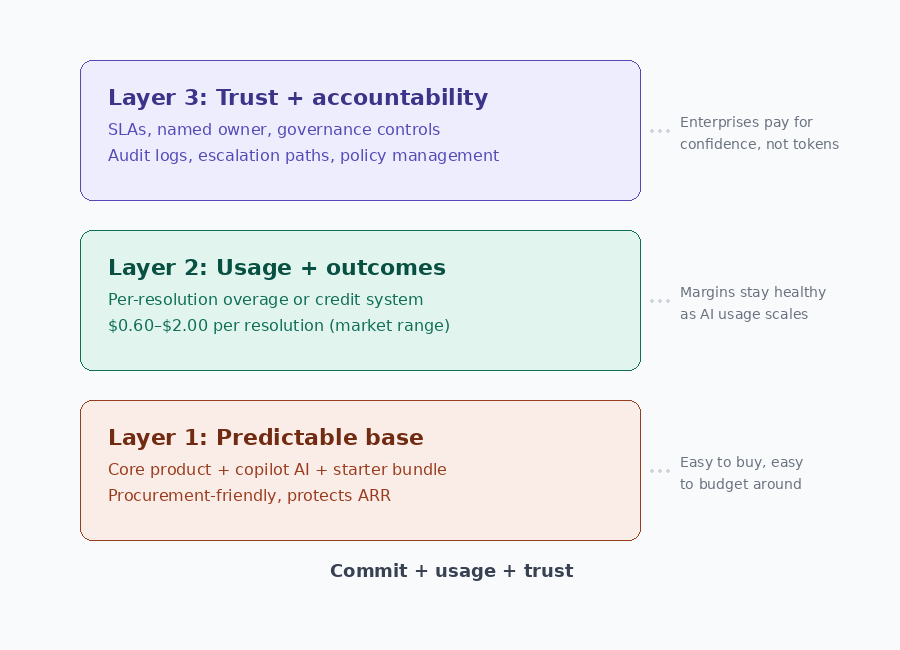
I keep coming back to the same answer: a hybrid pricing model. A predictable subscription base, a variable layer tied to usage or outcomes, and a premium tier that prices trust, governance, and accountability. Think of it as the cloud pricing playbook applied to AI: commit plus usage plus trust.
Here's what that looks like in practice, grounded in how the market is actually pricing AI support right now.
---
1) Three product surfaces you need to price separately
Most pricing mistakes happen because teams lump everything under "AI support" and hope the spreadsheet sorts it out.
You need to break it into three product surfaces, because the economics and risk profile of each one are different enough that a single pricing model will get at least one of them wrong.
Copilot (agent assist)
AI helping humans: summaries, suggested replies, auto-tagging, routing hints, tone adjustment. Customers like it because it makes their agents faster. You can price it per seat or bundle it into higher plans. It's good for adoption, less interesting as a margin driver.
Autonomous resolution (AI agent)
AI closing the loop on its own: answering the question, executing the action, closing the ticket without a human stepping in. This is where outcome pricing makes the most sense. It's also where you can burn trust fast if your definition of "resolved" is sloppy. Get the measurement right and this becomes your biggest margin lever.
Proactive support (enterprise posture)
AI preventing tickets from being created in the first place: detecting issues, spotting patterns, triggering remediations, notifying customers before they even notice something's wrong. Enterprises will pay real money for this, not because the AI is impressive, but because it reduces downtime and lowers renewal risk. What matters here is governance, not model quality.
Trying to price all three the same way means you'll overcharge for copilot, undercharge for autonomy, or give away proactive value for free.
---
2) What hybrid pricing actually looks like
It's not "subscription plus an AI add-on." It's a stack, and each layer is there for a reason.
Layer 1: Base subscription
This is the part that makes procurement comfortable.
Include the core product, copilot-grade AI features, basic self-serve improvements, standard analytics, and a small starter allowance for autonomous resolutions. That last part matters: you want customers to experience AI resolution without having to go through a second purchase process.
This protects your ARR, keeps purchasing simple, and gives every customer baseline AI coverage from day one.
Layer 2: Variable AI layer
This is the part that keeps your margins intact when AI usage takes off. You generally pick one of two approaches, or blend them.
Included outcomes plus overage. The plan includes a set number of verified resolutions per month. Beyond that, customers pay per resolution, with volume tiers that bring the unit price down as usage grows. This is already the most common model out there. Intercom, Zendesk, Gorgias, and Sierra all use variants, with per-resolution rates ranging from $0.60 to $2.00 depending on vendor, volume commitment, and plan level.
Credits or workflow units. Customers prepay credits that get consumed by expensive actions: deep diagnostics, tool calls, integrations, multi-step automations. This works better when the cost gap between resolutions is huge. A password reset might cost pennies. A multi-system diagnostic with tool execution might cost twenty times that.
Salesforce's pricing journey is a useful cautionary tale here. The $2-per-conversation model couldn't handle the difference between a simple FAQ lookup and a complex workflow triggering fifteen backend actions. The Flex Credits model at $0.10 per action was the fix, but by the time they shipped it, customers had already lost confidence in the pricing logic. The lesson is pretty straightforward: define what you're actually metering before you put a number on it.
Without a variable layer, here's what happens: your AI gets better, handles more volume, and every additional resolution is volume you're absorbing at a fixed price. Success becomes a cost problem.
Layer 3: Premium support entitlements
This layer is separate from AI usage entirely.
It includes SLAs and escalation paths, a named account owner, incident response, proactive risk reviews, and governance controls like audit logs, policy management, and permissions.
At this level, enterprises aren't paying for tokens or resolutions. They're paying for someone to pick up the phone when things go sideways, and for the confidence that AI-driven support won't blow up at renewal.
---
3) Define "verified resolution" or don't bother with outcome pricing
Outcome pricing works fine. Outcome pricing where nobody agrees on what "resolved" means is just a billing dispute you haven't had yet.
"Resolution" isn't standardized across the industry. Some vendors count any conversation where the customer didn't ask for a human. Others run an LLM verification check. Others require a cool-down window with no reopen. If your bar is too low, your numbers look great and your customers quietly lose trust.
A verified resolution should only count when one of these things is true: the ticket was closed and not reopened within a defined window (three to seven days is typical), the customer explicitly confirmed the issue was fixed, or a measurable success signal fired (a workflow completed, an error state cleared, something concrete happened).
Publish a resolution ledger
If you want enterprise buyers to accept outcome pricing, the billing has to be auditable. A monthly resolution ledger answers: how many outcomes were billed, what categories they fell into, which verification method applied, what the reopen rate looked like, and how cleanly escalations were handled.
You don't need to expose model internals or proprietary logic. You just need to make the invoice make sense.
The companion article, The Resolution Ledger, goes deep on ledger design. The short version: if you can't explain why you counted something as resolved, you shouldn't be charging for it. And once you retreat to pure subscription pricing because outcome billing felt too risky, your margins will take the hit as AI adoption grows.
---
4) The metrics that should govern pricing decisions
These aren't vanity metrics or dashboard decorations. These are the numbers that tell you whether to expand AI autonomy or pull it back.
Verified resolution rate
A realistic maturity curve: 15–25% in the first 90 days while you build knowledge coverage and tune guardrails. 30–50% at three to nine months as the system matures on high-frequency intents. 50–70% at nine to eighteen months on routine intents, assuming strong content hygiene and real integration depth.
For context, ecommerce brands with mature AI agents report 76–92% resolution rates on specific ticket types, but those numbers come from constrained intents and carefully maintained knowledge bases. The general-purpose number for a B2B SaaS product with mixed complexity will be lower than that.
Reopen rate on AI-resolved tickets
Under 5% early. Under 3% once mature. This is the honesty metric. If reopens creep up, either your resolution definition is too generous or you've pushed the autonomy boundary further than the system can actually handle.
Escalation quality
At least 90% of escalations should preserve full context so the human agent doesn't make the customer start over. This one directly supports premium support pricing. When handoffs are clean, the premium tier basically sells itself. When they're not, no amount of governance language on the pricing page will compensate.
CSAT parity with human baseline
Within one point early, then improving by one to three points on supported intents as the system matures. If CSAT drops, that's the signal to pause autonomy expansion and shift volume back to copilot-assisted human handling until you've figured out what went wrong.
Fully loaded AI cost per resolution
This number has to sit comfortably below whatever you're charging per outcome. And "fully loaded" means everything: inference, retrieval, tool calls, orchestration, evaluation, monitoring, knowledge base maintenance, and governance overhead.
To put some rough numbers on it: raw inference for a single resolution might cost $0.05 to $0.50, depending on model choice, conversation length, and tool calls. Flagship models currently run $3–$5 per million input tokens, budget-tier models $0.10–$1.00. But inference is usually only 30–50% of the total. Once you add retrieval, orchestration, evaluation, and governance overhead, the real number can double. If you're charging $0.99 per resolution and your fully loaded cost is $0.80, that margin is thinner than it looks on a slide.
One more thing worth flagging: Gartner's January 2026 projections suggest generative AI cost per resolution could exceed $3 by 2030, which would put it above what some companies pay offshore human agents today. The cost advantage of AI support is real right now, but assuming it will keep widening forever is a bet, not a fact. Build pricing that can handle cost floors, not just cost declines.
---
5) Why falling AI model costs should change your pricing strategy
AI model pricing has been falling 30–50% per year. The current generation of flagship models costs a third of what the previous one did. Budget-tier models good enough for straightforward support interactions cost less than a dollar per million tokens.
That has real implications for how you set prices.
Put annual pricing reviews in your contracts. If your underlying costs drop 40% in a year and your per-resolution rate stays fixed, your enterprise customers will notice eventually. Build in annual rate reviews or declining unit prices at volume thresholds. Cloud infrastructure contracts have worked this way for years. AI support contracts should too.
Route models by complexity. Not every resolution needs a flagship model. Simple intents can run through budget-tier models while complex, multi-step resolutions get the expensive ones. If you're processing every password reset through a $5-per-million-token model, you're burning margin for no reason.
Price tool execution separately. AI agents are increasingly doing real work: processing refunds, updating subscriptions, triggering remediations. When an agent actually changes state in a system, the value goes up and so does the liability. Charge differently for resolutions that involve tool execution versus ones that just provide information. Either use a higher per-outcome rate or a credit system where complex actions burn more.
---
6) The conversation-vs-resolution debate
There's a genuine argument happening in the market right now about whether per-resolution or per-conversation pricing is the better model.
The per-resolution camp (Intercom, Zendesk, Sierra, and recently HubSpot) says tying cost to outcomes aligns incentives between vendor and buyer. You pay for work that actually got done. Sierra built a $150M+ ARR business on this model in under two years, so the market clearly has appetite for it.
For reference, here's where per-resolution rates sit across the market right now: Gorgias at $0.60–$1.27 depending on plan tier, Intercom Fin at $0.99, Zendesk at $1.50 on committed volume or $2.00 pay-as-you-go, and Salesforce Agentforce at $2.00 per conversation or $0.10 per action via Flex Credits.
The per-conversation camp (Ada, and originally Salesforce) pushes back. Their argument: resolution-based pricing punishes vendors for getting better at automation, resolution definitions can be gamed, and conversation-based pricing is easier to budget around.
Honestly, both sides are making valid points. Resolution pricing creates alignment but needs rigorous definitions and real auditability. Conversation pricing is simpler to forecast but means you're paying the same rate when the AI fails as when it succeeds.
A hybrid model sidesteps this argument instead of picking a side. The base subscription gives you the budget predictability that conversation-based advocates care about. The variable layer gives you the value alignment that resolution-based advocates care about. The premium tier handles governance and accountability, which neither model addresses well on its own.
---
7) A practical hybrid pricing template
Template A: Base plus verified outcome overage
Works best when outcomes are clearly definable and cost variance between resolutions is moderate.
The base subscription covers the core product, copilot AI features, and a starter bundle of verified resolutions. Enough that a customer sees value before they hit overage. Higher tiers include larger resolution bundles at lower per-unit rates. Overage is priced per verified resolution with volume tiers that decline as usage grows. Premium support is a separate line item with governance controls, audit access, escalation SLAs, and a named account owner.
For a mid-market SaaS product, a rough structure might be: a base plan including 200 verified resolutions per month, a growth plan including 1,000 at a lower unit rate, published overage rates that step down at 2,500 and 5,000 resolutions, and a premium support add-on with governance, SLAs, and a monthly resolution ledger.
Template B: Credits plus workflow units
Works best when the cost difference between resolutions is dramatic.
Credits fund all AI actions. Simple answers burn a few credits, complex multi-system resolutions burn a lot more. The premium tier adds governance, audit logs, a larger prepaid credit bundle, and priority escalation.
This model fits when "a resolution" can mean anything from a two-sentence FAQ answer to a fifteen-step workflow hitting three external systems. Salesforce's shift from flat per-conversation to per-action credits was essentially an admission that this variation exists and can't be priced away.
---
8) Hybrid AI support pricing checklist
Packaging. Copilot is priced separately from autonomous resolution. Premium entitlements are separate from usage. Proactive support is positioned as retention and risk reduction, not as another AI feature.
Metering. Your verified resolution definition is explicit and published. Reopen windows and dispute mechanics are documented. A monthly resolution ledger exists or is on the roadmap.
Budget safety. Included allowances let customers adopt without a second procurement cycle. Caps and alerts are available. Prepay options exist for customers who want cost certainty.
Trust and governance. Escalation preserves context, and you're measuring the preservation rate. Guardrails exist for tool execution. Evaluation gates control autonomy expansion. Audit logs are accessible to the customer.
Pricing durability. Annual rate reviews are built into contracts. Model routing keeps cost per resolution as low as it can be. Tool-executing resolutions are priced differently from information-only ones.
---
Where this lands
I think hybrid pricing is the right model for most B2B SaaS companies selling AI support because it doesn't pretend that one pricing logic can cover three very different kinds of value.
Subscriptions keep procurement happy. Variable pricing protects margins as usage scales. Premium tiers give enterprise buyers the accountability they actually care about.
The companies pulling this off right now, Intercom, Zendesk, Sierra, all got to strong positions because they connected price to value and made billing transparent. Salesforce's three-model pile-up is what happens when you ship a price before you've figured out what you're actually selling.
Figure out your unit of value. Make the bill something a customer can actually read. Build in flexibility for when infrastructure costs inevitably shift. Then get out of the way and let the AI do its job.